.png)
How AI in Police Training Improves Retention and Readiness


TL;DR
About 1 in 7 recruits leave police training before graduation.
Most training still prioritizes lectures over live communication.
Voice-driven AI simulations let recruits practice real conversations, not just procedures.
Repetition and feedback—not hardware—drive retention.
Early data show higher engagement, faster learning, and better instructor efficiency.
The next frontier: making professionalism measurable and auditable.
1. The Problem: High Attrition, Low Realism
Police training in the United States loses valuable recruits before they ever reach the street. According to the Bureau of Justice Statistics (BJS, 2022), about 14% of recruits fail to complete basic training—8% are involuntarily dismissed, 5% withdraw voluntarily, and roughly 1% leave for other reasons.
Roughly one in seven recruits never finish the academy — a silent loss of both talent and taxpayer dollars.
Each dropout represents lost funding and potential talent. Many recruits exit not because they are unfit, but because the system still teaches policing as paperwork rather than people work.
Typical weaknesses:
Lecture-heavy curricula. BJS curriculum tables show that scenario or reality-based work occupies only a fraction of total training hours.
Instructor fatigue. Trainers must act out roles, reset scenes, and monitor recruits simultaneously.
Uneven feedback. A recruit may pass a test yet never practice responding to verbal hostility or emotional escalation.
When the first real confrontation happens—often under stress and public scrutiny—weak communication becomes the costliest failure.
2. Why Conversation Matters More Than Choreography
Policing is 80% communication and 20% control. A calm voice, clear command, or empathic question often matters more than tactical movement. Yet most academies still teach “choreography” (where to stand, how to move) instead of “conversation” (how to connect).
Voice-driven simulation reframes the problem:
Recruits speak naturally; the system listens and responds through AI personas.
The simulation interprets tone, phrasing, and context, then reacts in real time—no headset required.
Each scenario branches based on what the trainee says and how they say it.
As Violakis (2025) notes in Policing: A Journal of Policy and Practice, large language models can now sustain dynamic, branching dialogues that mimic real encounters.
AI makes conversation measurable—something role-play never truly achieved.
The result: conversation becomes a measurable, repeatable skill rather than an improvisation.
Instructor advantage:
Freed from acting roles, they can supervise several recruits at once.
All dialogue is logged and time-stamped for precise review.
Feedback shifts from “how it felt” to what was actually said.
3. How Learning Actually Sticks
Research across military, medical, and police education shows consistent patterns:
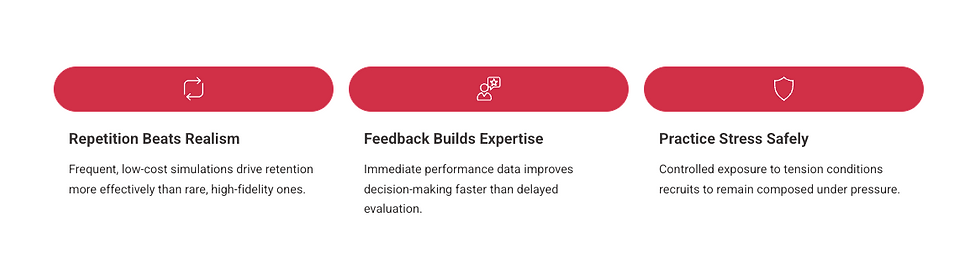
Repetition beats realism. Frequent, low-cost simulations drive retention more effectively than rare, high-fidelity ones.
Feedback builds expertise. Immediate performance data—tone analysis, timing, escalation markers—improves decision-making faster than delayed evaluation.
Stress must be practiced safely. Controlled exposure to tension (verbal aggression, noise, time limits) conditions recruits to remain composed.
Coaching replaces acting. With AI handling the role-play, instructors focus on reflection and judgment—what separates training from rehearsal.
A growing body of research supports these principles. Studies in simulation-based learning show that structured repetition and feedback outperform lecture-only instruction in knowledge retention and transfer.
4. Early Evidence of AI in Police Training
What’s supported so far:
Conversational realism: LLM-based simulations can reproduce branching interactions with situational relevance (Violakis, 2025).
Efficiency: Early academy pilots report shorter reset times and higher participation rates, though most data remain qualitative.
Engagement: Recruits report greater focus when speaking naturally rather than following scripts.
Accessibility: Browser-based delivery avoids the logistical limits of hardware-heavy VR.
What remains early-stage:
Long-term metrics—graduation rates, complaint reductions, field performance—are still being collected.
“Hours saved” and “fewer remedial sessions” are anecdotal, not yet validated across agencies.
Standardization may reduce bias, but only if datasets and feedback loops are audited for fairness.
Risks to manage
Bias and dialect gaps: Speech models can misinterpret accent or phrasing; audits are essential.
Gaming the system: Trainees may learn to “please the AI” instead of improving real-world empathy.
Cultural resistance: Instructors and unions may view simulation as depersonalizing until clear evidence builds trust.
Privacy and governance: Data retention, transparency, and auditability must match statutory and POST standards.
5. Beyond Headsets: Why Voice Beats Visual
Virtual reality (VR) still plays a role, but its limits are clear:
High cost and hygiene concerns. Headsets require cleaning, maintenance, and space.
Limited dialogue. VR excels at visual immersion, not verbal nuance.
Event, not habit. Because of setup time, many academies use VR sparingly—an occasional drill, not daily training.
An ACM review (2024) and related studies note that the future of simulation will likely be conversational and accessible—browser-based, voice-driven, and data-rich.
Language, not graphics, is what determines judgment under pressure.
6. Toward Standardized, Measurable Training
Simulation logs create a new feedback layer:
For instructors: Dashboards highlight recurring weaknesses (e.g., hesitation before commands, escalation phrasing).
For agencies: POST commissions can compare academy outcomes with objective data.
For policymakers: Training becomes traceable—every decision, recorded and reviewable.
Standardization brings bureaucratic virtue: consistent exposure, early detection of weak areas, and defensible proof of effort.
Technology itself isn’t reform. But it makes reform measurable, and measurement is what modern oversight demands.
7. The Future: Practice That Builds Trust
Every graduate fluent in calm communication reduces the chance of escalation on the street. Simulations cannot teach empathy outright, but they can rehearse the moments where empathy counts.
Voice-driven platforms such as Kaiden AI already enable academies to:
Scale conversation-first scenarios without role-players
Standardize evaluation criteria
Track improvement through instructor dashboards
When communication becomes quantifiable, professionalism becomes teachable.The technology may be new; the lesson is ancient: practice makes professionalism.
If you’re an academy leader or instructor, connect with Kaiden AI to explore how scenario-based AI training can strengthen your program.
